I have another question for you this morning. I call it the question of the ages. For in my mind, there’s no more important question that can be asked of any living human being residing on the face of this planet. For the answer to this question will forever shape the future of the one who accepts the challenge to answer it.
Matthew and Luke join Mark in providing this little vignette, in which Jesus takes His followers aside to ask this vital question: “Who do you say I am?”
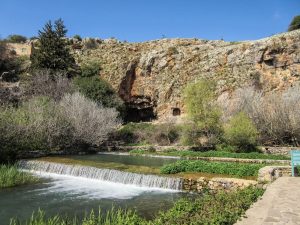
But before we go any further, it is interesting to note the place Jesus took them to ask this vital question. Caesarea Philippi is located 25 miles north of the Sea of Galilee region which served as a base of operations for Jesus. It was in the time of Jesus a very modern Greco-Roman city located at the base of Mt. Hermon which rises up 9,200 feet above sea level. The question is why would Jesus take the time and trouble to make a 50 mile round trip journey on foot to make this inquiry?
Caesarea Philippi was known for being associated with the four main religions of that part of the world at the time. There is a large cave that was said to have been the birthplace of the Greek god Pan. Also, note the head of the Jordan River which springs from underground to make its journey south to the Sea of Galilee and into the Dead Sea. We know that the Jordan River was very much associated with the Jewish religion, being mentioned 175 times in the Old Testament. Notice also in this picture the man-made cut-out in the face of the rock. This was one of no less than 14 little shrines that honored the Old Testament Canaanite storm-god Baal. Finally, Herod the Great had a large white marble Temple built here to honor Caesar Augustus, who demanded to be worshipped as a god.
So Jesus leads His followers on this pilgrimage to a place steeped in religion to ask, “With these four major world religions looking down on us, who do you say that I am? In other words, people, where and how do you think I fit in?”
Talk about raising the bar, I found this true story online where the author says: “Last weekend, a group of my friends were waiting in line for a concert in the city. My girlfriend excitedly started pointing at a hotel a few blocks away; ‘Look at the top of that building! I think that’s an indoor pool on the top floor!’ A debate started about whether or not it was actually a pool, until I stated that it was obviously a bar. ‘Why do you say that?’ said my girlfriend. ‘Because nice hotels like to set the bar high.’ I’ve never been prouder to make a group of people groan.” 1
Talk about groaners, perhaps it’s time for me to raise the bar on the jokes I tell!
Talking about raising the bar, my grandson, Matthew, is a high jumper; a very good high jumper.
In the sport of high jumping, when a participant clears a particular height they raise the bar another inch, and when the jumper clears that height, they raise it another inch. Why do they raise the bar? Raising the bar creates interest for the spectators. And raising the bar creates competition for the participants and, therefore, the incentive to become better.
What motivation would there be for Matthew to keep striving to be better if the bar was left at 6’ 1”? How many times would he clear 6’ 1” before his interest would begin to wane?
There’s something about raising the bar that brings out the best in a person! And in a church!
Just ask Jesus, who in His Sermon on the Mount, is obviously intent on raising the bar for His followers.
“You have heard that our ancestors were told, ‘You must not murder. If you commit murder, you are subject to judgment. But I say, (raise the bar) if you are even angry with someone, you are subject to judgment!” (Matthew 5:21-22).
“You have heard the commandment that says, ‘You must not commit adultery.’ But I say, (raise the bar) anyone who even looks at a woman with lust has already committed adultery with her in his heart” (Matthew 5:27-28).
Four more times in this chapter, Jesus uses the same formula “You have heard it said, (lower the bar), but I say (raise the bar) to you.”
And if the bar hasn’t been raised high enough, Chapter 5 concludes with Him saying, “You must be perfect, even as your Father in heaven is perfect” (Matthew 5:48).
According to W. E. Vine’s Expository Dictionary of New Testament Words ‘perfect’ means, ‘finished’ or ‘completed’ as in ‘having reached its end;’ and therefore, implies a ‘growing process’ into Christlikeness. 2
If we are going to work toward achieving that goal, we are going to have to raise the bar.
“Unless you try to do something beyond what you have already mastered, you will never grow.” 3
The apostle Paul follows the example of Jesus by continually raising the bar for the churches he writes to. “Finally, dear brothers and sisters, we urge you in the name of the Lord Jesus to live in a way that pleases God, as we have taught you. You live this way already, and we encourage you to do so even more” (I Thessalonians 4:1). Or as the NASB has it: “that you excel still more.”
If you and I are going to grow individually to become more like Jesus; if we are going to become the kind of church that Jesus is calling us to be, we must talk about raising the bar. As followers of Christ, we must never settle for the status quo, we must refrain from falling into the trap of becoming satisfied and, therefore; complacent with who we are and where we are on our journey toward Christ. Rather, we must always be moving upward to reach new heights as individuals and consequently as a church.
Oliver Wendell Holmes wrote “I find the great thing in this world is not so much where we stand, as in what direction we are moving: To reach the port of heaven, we must sail sometimes with the wind and sometimes against it; but we must sail, and not drift, nor lie at anchor. 4
So, what are some ways that we can raise the bar at CrossPointe?
We can become a High Expectation Church.
Our leaders are currently being trained in church revitalization by watching 26-30 minute video presentations by the noted pastor, author, church consultant Thom Rainer. He talks about the importance of raising the bar as it concerns having high expectations of church members. And one of his most practical ways to raise the bar is to have a new member’s class.
We will name it something different because we don’t have official membership. So perhaps we’ll call it Christianity or Discipleship 101.
I have designed the components for such a class and plan on offering the curriculum on an as needed basis to new people who begin to attend CrossPointe. As I began thinking about this, it occurred to me some of you would feel left out. I also thought it would be beneficial for all of us to participate in such an endeavor. At the same time, I knew that it would be a daunting task to arrange and organize multiple classes to accommodate all of our timing needs. So it made perfect sense to me to hold these membership classes on Sunday mornings at 10:30am!
So, yes for the next several weeks, my messages will encompass the material that will be included in a Discipleship 101 class. To be sure, all the information conveyed will be based upon the word of God. We will cover the topics of what does it mean to be a Christian, what does it mean to grow in Christ, and it means to be part of the body of Christ.
Rainer went on to mention another way to raise the bar is through preaching. I mentioned before Christmas that I would like to dig a little deeper in my preaching this year. After Discipleship 101, look for a sermon series on how to overcome temptation. And after Easter I will begin some expository, as opposed to topical preaching, as we will make our way verse by verse through book(s) of the Bible.
In these ways, we will be raising the bar at CrossPointe.
That great 19th century preacher, pastor, author and teacher, F. B. Meyer, wrote: The law for Christian living is not backward, but forward; not for experiences that lie behind, but for doing the will of God, which is always ahead and beckoning us to follow. Leave the things that are behind, and reach forward to those that are before, for on each new height to which we attain, there are joys that befit the new experience. Aim high, press forward, the best is yet to be! 5
For many years Admiral Hyman Rickover was the head of the United State Nuclear Navy. His admirers and his critics held strongly opposing views about the stern and demanding Admiral. For many years every officer aboard a nuclear submarine was personally interviewed and approved by Rickover. Among them was Ex-President Jimmy Carter who, years ago, applied for service under Rickover. This is his account of a Rickover interview:
I had applied for the Nuclear Submarine Program, and Admiral Rickover was interviewing me for the job. It was the first time I met Admiral Rickover, and we sat in a large room by ourselves for more than two hours, and he let me choose any subjects I wished to discuss. Very carefully, I chose those about which I knew most at the time, current events, seamanship, music, literature, naval tactics, electronics, gunnery, and he began to ask me a series of questions of increasing difficulty. In each instance, he soon proved that I knew relatively little about the subject I had chosen. He always looked right into my eyes, and he never smiled. I was saturated with cold sweat. Finally, he asked a question and I thought I could redeem myself. He said, “How did you stand in your class at the Naval Academy?” Since I had completed my sophomore year at Georgia Tech before entering Annapolis as a Plebe, I had done very well and I swelled my chest with pride and answered “Sir, I stood fifty-ninth in a class of 820!” I sat back to wait for the congratulations which never came. Instead the question came. “Did you do your best?” I started to say, “Yes, sir”, but I remembered who this was and recalled several of the many times at the Academy when I could have learned more about our allies, our enemies, weapons, strategy, and so forth. I was just human. I finally gulped and said, “No, sir, I didn’t always do my best.”
He looked at me for a long time, and then turned his chair around to end the interview. He asked one final question, which I have never been able to forget or to answer. He said, “Why not?” I sat there for a while shaken, and then slowly left the room. 6
In the old days, about the only method used to bring about what we today call ‘church revitalization’ was the old fashioned revival.
In one town, three churches sponsored a joint revival. After it was over, the three pastors met for coffee to discuss the results.
The Methodist pastor said, “The revival worked out great for us! We gained four new families.”
The Baptist preacher said, “We did better than that! We gained six new families.”
The Presbyterian minister said with a sly grin, “We did even better than that! We got rid of our ten biggest troublemakers!”
Jesus is the architect of church revitalization because He is the architect of His Church!
The great Apostle Paul testifies of Him in his letter to the Ephesians: “He is far above any ruler or authority or power or leader or anything else; not only in this world but also in the world to come. God has put all things under the authority of Christ and has made Him head over all things for the benefit of the church. And the church is His body; it is made full and complete by Christ, who fills all things everywhere with Himself” (Ephesians 1:21-23).
When it comes to church revitalization, Jesus is the champion, the cheerleader, the chief executive, and the head coach. He is the Creator, Savior, and Sustainer of His Church and because He is He has a vision for His Church to be the very best it can be! As evidenced in the letters to the seven churches of Revelation 2 and 3, where His major thrust is revitalizing those local congregations: to set right what is broken, to rebuke what is false, and to give new life to what is dying; in other words to revitalize!