Month: October 2019

  • Taming Troubles

    Habakkuk 3:17-19
    James 1:2-4

    Let’s play a little Trivial Pursuit:
    1. Who is known as the Bard of Avon?
    William Shakespeare.
    2. Which Shakespearean play is most associated with All Hallow’s Eve?
    Macbeth.
    3. What is the common name of the poem recited/sung by the three witches?
    Double, Double, Toil and Trouble.
    4. When it comes to troubles, the one-hit-wonder group, the Fortunes had a 1965 hit song that all of us can say amen to: You’ve Got Your Troubles, I’ve Got Mine.
    5. One last trivia question: what Old Testament and what New Testament authors equate trouble with joy?
    And the answer is: Habakkuk and James.

    Even though the fig trees have no blossoms, and there are no grapes on the vines; even though the olive crop fails, and the fields lie empty and barren; even though the flocks die in the fields, and the cattle barns are empty, yet I will rejoice in the Lord!
    I will be joyful in the God of my salvation! The Sovereign Lord is my strength! He makes me as surefooted as a deer, able to tread upon the heights. (Habakkuk 3:17-19).

    Dear brothers and sisters, when troubles of any kind come your way, consider it an opportunity for great joy. For you know that when your faith is tested, your endurance has a chance to grow. So let it grow, for when your endurance is fully developed, you will be perfect and complete, needing nothing. (James 1:2-4).

    Notice James doesn’t say “If” trouble comes, but rather, “When.”

    Troubles are as old as Adam and Eve, who I guess we can blame for all of ours.

    Jesus said, “In this world you will have trouble. But take heart! I have overcome the world” (John 16:33).

    Many, if not all of us, are experiencing some sort of trouble right now.

    (more…)

  • Objections to Grace

    Matthew 20:1-16
    Luke 15:25-32

    Speaking of sibling rivalries, a twin brother says, “I finally realized my father favored my brother over me. It hit me when they asked me to blow up balloons for his surprise birthday party!”

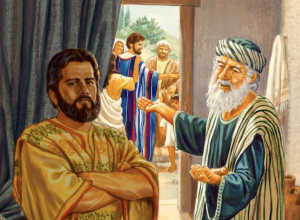
    If this parable were a play and we were sitting in the audience watching it for a second time, knowing the older brother is really upset because his father not only welcomed his younger brother home but threw him a party as well, how would we respond when the older brother appears in this final scene? How many of us might have been tempted to boo the older brother’s boorish behavior as he makes his way to center stage? On the other hand, how many of us would tend to sympathize with him?

    Could it be that there’s a little of the older brother in all of us?

    My premise for today is that, for the same reasons the older brother did, we have this inbred tendency to struggle with the concept of grace. And if we are not careful, that struggle can keep us from living in freedom.

    First, we struggle with grace because we can’t quite accept the idea that something as good as grace is free.

    Hearing that younger brother had been welcomed home by their father with a party, older brother responds with, “All these years I’ve slaved for you and never once refused to do a single thing you told me to” (Luke 15:29a).

    Like the older brother, many people today labor under the illusion that we must work to earn God’s blessings. Ask the average joe on the street, “How do you get into heaven?” and he will quickly answer, “Be good.”

    A Sunday school teacher had been teaching his 7th graders for several weeks about receiving the free gift of God’s grace. “If I sold my house and my car, had a big garage sale and gave all my money to the church, would that get me into Heaven?”
    “NO!” the children all answered.
    “Okay, if I cleaned the church every day, mowed the yard, and kept everything neat and tidy, would that get me into Heaven?”
    Again, the answer was a resounding, “NO!”
    “Well, then, if I was kind to animals and gave candy to all the children, and loved my wife, would that get me into Heaven?”
    Again, they all answered, “NO!”
    “Well, then he continued, “Then how can I get into Heaven?”
    And little Larry shouted out, “YOU GOTTA BE DEAD!”

    (more…)
  • The Father’s Extravagant Love

    Philippians 2:6-11
    Luke 15:11-24

    Because it is often easy to get lost in the forest for the trees, I’d like for us to take a step back and take a gander at the big picture.

    In Luke 15, Jesus weaves together these three splendid stories so that His listeners will be enabled to comprehend something about who His Father is and what He is like. In contrast to the thinking of the day held by the religious teachers, that certain people (the poor, lepers, women, tax collectors, gentiles, sinners) did not matter to God; and therefore, were to be shunned; Jesus paints a picture, especially in the story of the prodigal son, of a God that is always seeking, constantly searching for ALL lost souls and is filled with great joy when those lost souls allow themselves to be found.

    Last week, the focus was on the prodigal son; especially as it concerned him coming to his senses and then making a decision to return to his father’s home. And I posed the thought-provoking question, Is it possible that some of us might be living between coming to our senses and coming home? And I encouraged all of us to consider making a decision to come home.

    Today, I want to explore the actions of the father of the prodigal.

    But before I read the story of the prodigal son, I would like to do some Bible Study with you aided by Professor of Theology, Kenneth Bailey, who for over 20 years of lived and taught throughout the middle-east. Bailey penned four books on Luke 15, including this one, Jacob and the Prodigal.

    Bailey notes that we often think of this parable solely in terms of featuring three people; the father, the son and the older brother who appears at the end of the scene. However, reading between the lines affirms what Bible scholars know, that the stories Jesus tells are about people living in community.

    (more…)