Listen to Sermon Audio
John 11:1-53, I Corinthians 15:12-22
A pastor’s son and his friends were playing in the backyard when they found a dead robin. They decided that the bird should be given a proper burial, so they put him in a Kleenex box, dug a hole and solemnly placed their feathered friend in the ground. Naturally, the minister’s son was chosen to say something appropriate. Remembering what his father often said at times like this, the young boy sang, “Glory be to the Father, and to the Son…and into the hole he goooooes!”
On Feb. 27, 1991, at the height of Desert Storm, Ruth Dillow’s worst fears were realized as she opened her front door to see two army officers standing there with grim looks on their faces. She knew why they were there. It was their job to inform her that her son, Pvt. 1st Class, Clayton Dillow, had stepped on a landmine in Kuwait and was now dead. She later said, “I can’t begin to describe my grief and shock. It was almost more than I could bear. For 3 days I wept, for 3 days I expressed my anger toward God, for 3 days people tried to comfort me, but to no avail, because the loss was too great.”
Then, three days after she received that dreaded message the telephone rang. The voice on the other end said, “Mom, it’s me, I’m alive.” Ruth Dillow said, “I couldn’t believe it at first. But then I recognized his voice, and he really was alive. The army had made an identification mistake! I laughed, I cried, I felt like turning cartwheels because my son whom I had thought was dead . . . was really alive. I’m sure none of you can even begin to understand how I felt.”
It’s probably true that none of us can, but two sisters who made their home in a place called Bethany could and did.
As we join Mary and Martha, we come to a very heavy scene of mourning with all the reality of grief, heartache, and tears. The Bible doesn’t gloss over what we are so afraid to talk or even think about. (more…)
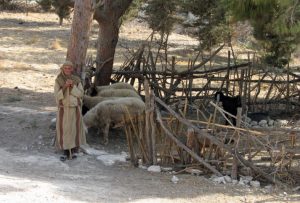 Now, during the warm season, the shepherds would take the sheep out to range for weeks at a time, and at night they would enclose the sheep in folds that were simply walls about 4 feet high that enclosed a space with an open entrance. There was no door to that entrance. Once all the sheep were in the fold, the shepherd himself would lay down across the opening and thus was the door. And for the sheep to enter or depart from the sheepfold, they had to pass over the shepherd’s body. It was that kind of sheepfold Jesus is talking about in this next section where he refers to Himself as the door. 2
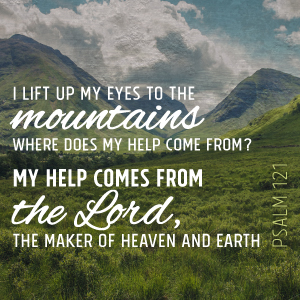 The same could be said of the writer of the 121st Psalm: “I will lift up my eyes unto the hills, from whence cometh my help. My help cometh from the Lord.” We don’t know the historical context for the writing of this Psalm, but it’s not hard to imagine that for whatever reason he was downcast. His opening line “I will lift up my eyes” implies that he had been focusing in the opposite direction. And perhaps someone has reminded him as he reminds us that when we are feeling down we need to lift up the eyes of our souls and fix our gaze on heavenly things and therein rediscover hope.
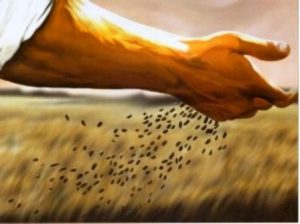 In his The Treasury of David Commentary, the 19th-century English preacher, Charles Haddon Spurgeon writes:
 It’s no wonder then, that before He ascended into heaven, Jesus told His disciples that they were going to be His witnesses. In those words, the torch was being passed from the Jewish people to the Church comprised of all those who have embraced Jesus as the Son of God who came to give His life for the forgiveness of sins. We are His witnessing people. Individually and collectively, we are given the privilege of shining light in the darkness, of sharing God’s grace with the community. Be it our church sharing God’s grace with the community of Chippewa Lake or you as an individual sharing God’s grace with your community of folks; that is those in the sphere of your influence.