Category: Podcasts

  • Come Lord Jesus!

    Matthew 24:1-44
    I Thessalonians 4:13-18

    Destiny came down to an island, centuries ago, summoned three of the inhabitants and asked, “What would you do if I told you that tomorrow your island will be completely inundated by an immense tidal wave?”
    The first man, who was a cynic, said, “Why, I would eat, drink, be merry all night long!”
    The second man, a mystic, said, “I would go to the sacred grove with my loved ones and make sacrifices to the gods and pray without ceasing.”
    And the third man, who loved reason, thought for a while, and finally said, “I would assemble our wisest men and begin to study how to live underwater.”

    What would you do if I told you that tomorrow we would experience the most cataclysmic event in world history? An event more dramatic than when the heavens opened and for forty straight days a deluge fell upon the earth almost wiping out the entire species of Homo-sapiens.

    What would you do, if you knew without doubt that Jesus was going to return tomorrow?
    Not as a helpless baby who after His birth was seen by only a select few. But as the Son of Man preceded by trumpet sounds and coming on the clouds with power and great glory, in such a way that all people everywhere would see Him at once?

    What would you do today if you knew tomorrow Jesus would return, as He promised He would, to initiate that mysterious sequence of events associated with the end of time as we know it?

    Would you like the man of reason, begin to figure a way to live with the negative consequences of such an event? Or would you be the mystic sacrificing and praying as you waited? Or would you just carry on, life as usual, like Noah’s neighbors, who were warned that a little rain was going to fall, but who were content for years to eat, drink, and be merry?

    For to be sure, a few days before Jesus suffered and died on the cross He spoke to His followers about the things that would come in the “last days” and delivered a similarly clear message: “I am coming again, at a time you cannot know and will least expect; so I advise you . . . if you are not ready . . . get ready!”

    I want to discuss just two aspects of the second coming of Christ. (more…)

  • Thanks Be to God

    II Corinthians 9:6-15

    Every night about 9:30 pm, unemployed, homeless and hungry men gather under the elevated train in Queens, NY; where relief comes in the form of Jorge Munoz’s white pickup truck, filled with hot food, coffee, and hot chocolate. The men eagerly accept containers of chicken and rice from Munoz. For many, this is their only hot meal of the day. One of the regulars says, “I thank God for touching that man’s heart.”

    Munoz began his meal program, now his nonprofit, in the summer of 2004 when he and his mother began preparing 20 home-cooked meals daily. Numbers gradually increased over the years to 35, 60 and now about 140. Munoz estimates he has served more than 70,000 free meals since 2004. Sustaining this endeavor consumes most of his life. He and his family are funding the operation through their savings and his weekly $700 paycheck.

    Asked why he spends so much time to help people he doesn’t know, he answers, “I am grateful for a stable job, my mom, my family, a house; everything I want I have. And these guys don’t, so I just think, ‘OK, I have the food.’ At least for today, they’re going to have a meal to eat.” 1

    Jorge Munoz illustrates what Paul is talking about in II Corinthians, where in five verses he uses the words ‘thanks’ and ‘generosity’ three times each. In other words, ‘gratitude’ (thanksgiving) and ‘generosity’ are kissing cousins. It is because Munoz is content and thankful for what he already has that he is able to act out of that gratitude and freely express generosity.

    Gratitude; being thankful for the many blessings we have leads to generosity, which then leads to expressing thanksgiving. So really thanksgiving and generosity are more than kissing cousins, they’re cyclical in nature; gratitude leads to generosity which leads to gratitude. (more…)

  • Cheerful Giving

    Luke 21:1-4
    II Corinthians 8:1-5, 9, 9:6-7

    So, “God loves a cheerful giver” does He? Really, a cheerful giver? Isn’t that an oxymoron? Like awfully good, diet ice cream, fine mess, jumbo shrimp, Microsoft works, pretty ugly, small crowd; cheerful giver? At first glance, we’re only cheerful about giving when we fork over our hard-earned dough on ourselves.

    On Sunday morning a father gave his son a couple of quarters and a dollar. “Put the dollar in the offering, and you can have the 50 cents for ice cream.” When the boy came home, he still had the dollar. “Why didn’t you put the dollar in the offering? his father asked. “Well, the preacher said that God loves a cheerful giver. I gave the 50 cents a whole lot more cheerfully than I could the dollar.”

    On the other hand, author, philosopher, historian Thomas Carlyle tells how, when he was a boy, a beggar came to the door. His parents were out and he was alone in the house. On a boyish impulse, he broke into his own savings bank and gave the beggar all that was in it. And he tells us that never before or since did he know such sheer happiness as came to him in that moment.
    Is it possible to give cheerfully? I think so. And I’ll tell you how it’s possible. (more…)

  • A Change of Heart

    Luke 19:1-10
    I Timothy 6:6-19

    After worship one Sunday a little boy told the pastor, “When I grow up, I’m going to give you some money.”

    “Well, thank you,” the pastor replied, “but why?”

    “Because my dad says you’re one of the poorest preachers we’ve ever had.”

    This morning I am preaching my 820th sermon since I have been the Pastor of CrossPointe Community Church. Of those 820 messages, a scant 28 have addressed the subject of how our wealth and possession affect our walk with Christ. That’s 1 and ¾’s of a sermon per year on this important to Jesus subject.

    How do we know it was important to Jesus? Because one-third of all the parables He taught have to do with the wise use of money and possessions. Because someone took the time to discover that 1 out of 6 verses spoken by Jesus directly bears on how His followers would handle money. By that reckoning, should have given 140 by now. So that means I owe you 111 or a little over two year’s worth to catch up.

    Why is this so? I’ll give you two or three reasons next Sunday. But for today let me say that in CrossPointe’s history, there haven’t been too many times when we as a church needed to address this for practical reasons.

    But now we need to.

    Last Sunday after worship Annie Dean presented CrossPointe’s Investment Plan for 2018.

    The figure of $133,326.69 represents the amount of money we will need to raise to meet our ministry goals for 2018. It covers things like staff salaries, utility needs and other operating expenses and ministry and outreach goals. When you divide the total by 52 Sundays in a year we need to average $2564 per week. So far this year our average is 2395 per week. So in order for us to meet our ministry goals, we will need to raise an average of $169 more per Sunday.

    But I’m not worried . . . for there is good news here. We have a lot of people who wholeheartedly believe in and therefore support this church. We have people in this church who have already wholeheartedly embraced the Biblical principles of faithful stewardship. And I am confident that we are ready to hear and respond to the word of God. (more…)

  • Camel Knees

    Luke 18:18-30

    “It is harder for a camel to go through the eye of a needle than for a rich person to enter the Kingdom of God.”

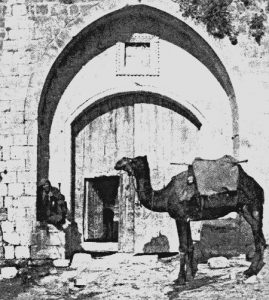
    If we had been within earshot of Jesus, we would have understood what He meant about a camel passing through the eye of a needle. Incorporated into the main gates to ancient cities there often stood a smaller gate, known as a needle’s eye, that was used mainly by pedestrians. The main gate was almost always closed at sunset and on the Sabbath for security purposes and to keep camels and their camel jockeys and their wares from entering the city. But people could still pass through if need be.

    Now once in a while, there was an insistent camel owner, who for whatever reason wanted to get inside the city walls even though the main gate had already been closed. Was that possible?

    Notice Jesus didn’t say it was impossible for a camel to go through the eye of a needle He said it was very difficult. In his commentary, Ivor Powell suggests it was difficult because it required three things:

    The animal had to be small; the load had to be taken from its back, and the camel, somehow, had to go forward on its knees. It could be done, but it was difficult. 1

    Because we who live in America are rich, it would do us well to consider the same three requirements for it is still harder for a camel to go through the eye of a needle than for a rich person to enter the kingdom of heaven.

    First, that person must be on the small size, not physically, but attitude-wise.

    For Jesus is more interested in the rich man’s attitude toward his wealth than anything else. (more…)

  • Little Is Much

    Luke 13:18-19

    A mustard seed is one of the tiniest of seeds. It is only slightly larger than a grain of sand.
    But a mustard seed contains something a grain of sand does not: Life. It grows into a beautiful mustard plant. Mustard plants can grow to be over eight feet tall.

    Jesus challenges us to understand that like that living seed, His Kingdom is alive and although often starts small, it grows very large as well.

    In 1924, Kitty Suffield wrote a song titled Little Is Much When God Is In It. Kitty was the pianist at a small church in Ottawa, Canada. The pastor had a teenage son who had a great singing voice but he was shy and lacking in confidence; besides what good would come from one boy singing a song. But Kitty encouraged him to offer his gift to the Lord. That boy’s name was George Beverly Shea, who grew up to sing to millions at the Billy Graham Crusades. Little is much when God is in it.

    In the scriptures little becomes much when God is in it.

    God tells Gideon he has too many warriors to do battle against the Midianite army
    after winnowing them down from 32,000 to 300, God gives the victory. Little is much when God is in it.

    I Kings 17 tell the story of a widow who because of a severe drought is down to her last bit of flour and oil. Elijah asks her to use the little she has left to prepare him a meal. And when she does, God provides her sustenance until the drought ends. Little is much when God is in it.

    A little boy offers Jesus five loaves and two fish which in the hands of Jesus end up feeding over 5,000. Little is much when God is in it. (more…)

  • Ham or Eggs or $3 Worth of God?

    Luke 9:18-27, 57-62; 10:25-28

    Have you ever heard the story of the hen and the hog? They were walking down the street and came to a church with a sign outside: “HELP THE NEEDY.” They started to talk about it.

    Hen: “I know how we could help. We could give them ham and eggs for breakfast.”

    The hog was horrified and said, “That’s fine for you only giving a partial contribution, but for me, it’s total commitment.”

    What’s the takeaway from that fable? Perhaps to consider whether we are offering ham or eggs to Christ.

    In 1675, a German pastor named Philipp Spener wrote a work called Pious Desires. With uncommon vigor, Spener insisted that too many ‘so-called Christians’ had only the outward form of religion without the power. His call to holiness and intentional Christian growth was so inspiring it launched a movement called Pietism, which heavily influenced John Wesley and many others and eventually led to the First Great Awakening. Tell me if you think what he wrote in 1675 still applies today:

    …there are not a few who think that all that Christianity requires of them (and that having done this, they have done quite enough in their service of God) is that they be baptized, hear the preaching of God’s Word, confess and receive absolution, and observe the Lord’s Supper, no matter how their hearts are disposed at the time, or whether or not there are fruits which follow. 1

    Sounds like what Wilbur Rees wrote 300 years later in his book, $3.00 Worth of God:

    I would like to buy $3.00 worth of God, please. Not enough to explode my soul or disturb my sleep, but just enough to equal a cup of warm milk or a snooze in the sunshine. I don’t want enough of Him to make me love a black man or pick beets with a migrant. I want ecstasy, not transformation; I want the warmth of the womb, not a new birth. I want a pound of the Eternal in a paper sack. I would like to buy $3.00 worth of God, please.” 2

    Luke 9:51 invites you and me to consider whether we desire $3.00 worth of God, or if we desire more. (more…)

  • Adoption Blessings

    Romans 8:15-16

    Last Sunday we gleaned three truths from Paul’s letter to the Ephesians about the process of being adopted into God’s family.

    1. Our adoption was planned from the very beginning:
      Even before He made the world, God loved us and chose us in Christ to be holy and without fault in His eyes. God decided in advance to adopt us into His own family by bringing us to Himself through Jesus Christ. (Ephesians 1:4-5)
      Creation, fall, redemption, adoption
    2. We were adopted despite the fact that from a human viewpoint we were unadoptable:
      Once you were dead because of your disobedience and your many sins. You used to live in sin, just like the rest of the world, obeying the devil—the commander of the powers in the unseen world. He is the spirit at work in the hearts of those who refuse to obey God. All of us used to live that way, following the passionate desires and inclinations of our sinful nature. By our very nature, we were subject to God’s anger, just like everyone else. (Ephesians 2:1-3)
      We are all in a basket of deplorable’s.
    3. A very high price was paid so that we could be adopted:
      He is so rich in kindness and grace that He purchased our freedom with the blood of His Son and forgave our sins. (Ephesians 1:7)

    Today I am turning to Paul’s letter to the Romans (8:15-16) where he also uses the word ‘adoption’ to flesh out three blessings of adoption

    So you have not received a spirit that makes you fearful slaves. Instead, you received God’s Spirit when he adopted you as his own children. Now we call him, “Abba, Father.” For his Spirit joins with our spirit to affirm that we are God’s children.

    First point; our adoption is irrevocable.

    I point this out because there are always Christians who are troubled by the thought that they have sinned away God’s grace. That is, we feel as if we have crossed the line with God one too many times. And that perhaps, as a result, He is through with us.

    And so I say loud and clear, that once we are adopted into God’s family, we are part of the family forever; permanently. (more…)

  • On Being Adopted

    Ephesians 1:1-8

    A first grader brought in a family picture for show and tell. One of the more astute first graders noticed that one of the little boys in the picture had different color hair than the other family members. Another child suggested that he was probably adopted. A little girl said, “I know all about adoptions because I was adopted.”
“What does it mean to be adopted?” asked the teacher.

    “It means,” said the little girl, “that you grew in your mommy’s heart instead of her tummy.”

    The Apostle Paul used many different kinds of images and metaphors to express the blessings of knowing Christ. He searched both the Old Testament and 1st century culture to find words that would create a new theological grammar for the fledgling church. Some of the words he chose to describe what we refer to as ‘salvation’ are “atonement,” “justification,” “reconciliation,” “redemption.”

    And as you have already guessed from today’s scripture reading and message title, one of them was “adoption.” The Greek word literally means, “to make [someone] a son”.  Paul used the word “adoption” five times in his letters: once in Galatians, (4:5); three times in Romans (8:14, 23; 9:4) and in today’s text in Ephesians (1:5).  In each case it refers to God’s adoption of us as His children.

    Today, I want to cover 3 things Paul lets us know about the adoption process in his letter to the Ephesians. And next week, we’ll discuss the blessings of being adopted into God’s family.

    First I note this process of adoption was planned long ago.

    Even before He made the world, God loved us and chose us in Christ to be holy and without fault in His eyes” (Ephesians 1:4).

    (more…)

  • Another Chance for Who?

    2 Peter 3:3-17
    Luke 13:1-9

    A priest and pastor from the local parishes were standing by the side of the road holding up a sign that read, “The End is Near! Turn around now before it’s too late!”

    “Leave us alone, you religious nuts!” yelled the first driver as he sped by.

    From around the curve, they heard screeching tires and a big splash. The Priest sheepishly looked at the Pastor and asked, “Do you think our sign should have simply said, ‘Bridge Out’ instead?”

    How many of you wondered with me last week whether or not the world was coming to an end? I mean, can you recall another time when so many natural disasters were occurring so close together? There were hundreds of people in Texas clinging to rooftops waiting to be rescued as the waters from Hurricane Harvey threaten to engulf them; wild-fires burning out of control in several western states prompting warnings to stay indoors to avoid breathing toxic air; an 8.1 earthquake in Mexico toppling buildings and spawning tsunamis and five unusually strong solar flares spewing a torrent of electromagnetic radiation toward our fragile planet. And then came Irma.

    It is times like these that make us who believe in God to wonder, where is God in all of this? Does He not see what’s happening? Does He not care? Is He the one who we should hold responsible?

    Not according to actress Jennifer Lawrence, who said last week that the two devastating hurricanes in Texas and Florida are expressions of Mother Nature’s wrath and anger over the election of Donald Trump. I didn’t know the Donald had that much power!

    In today’s passage from Luke, Jesus perceives that His listeners are grappling with similar causality questions concerning a natural disaster.

    Perhaps an earthquake, perhaps faulty engineering, perhaps a combination of both caused some sort of tower to collapse in the Village of Siloam killing 18 people and doubtless injuring others. The prevailing thinking of the day is that things of that nature were God’s justice meted out toward evil sinners. Jesus quickly nixes that theology: (more…)